
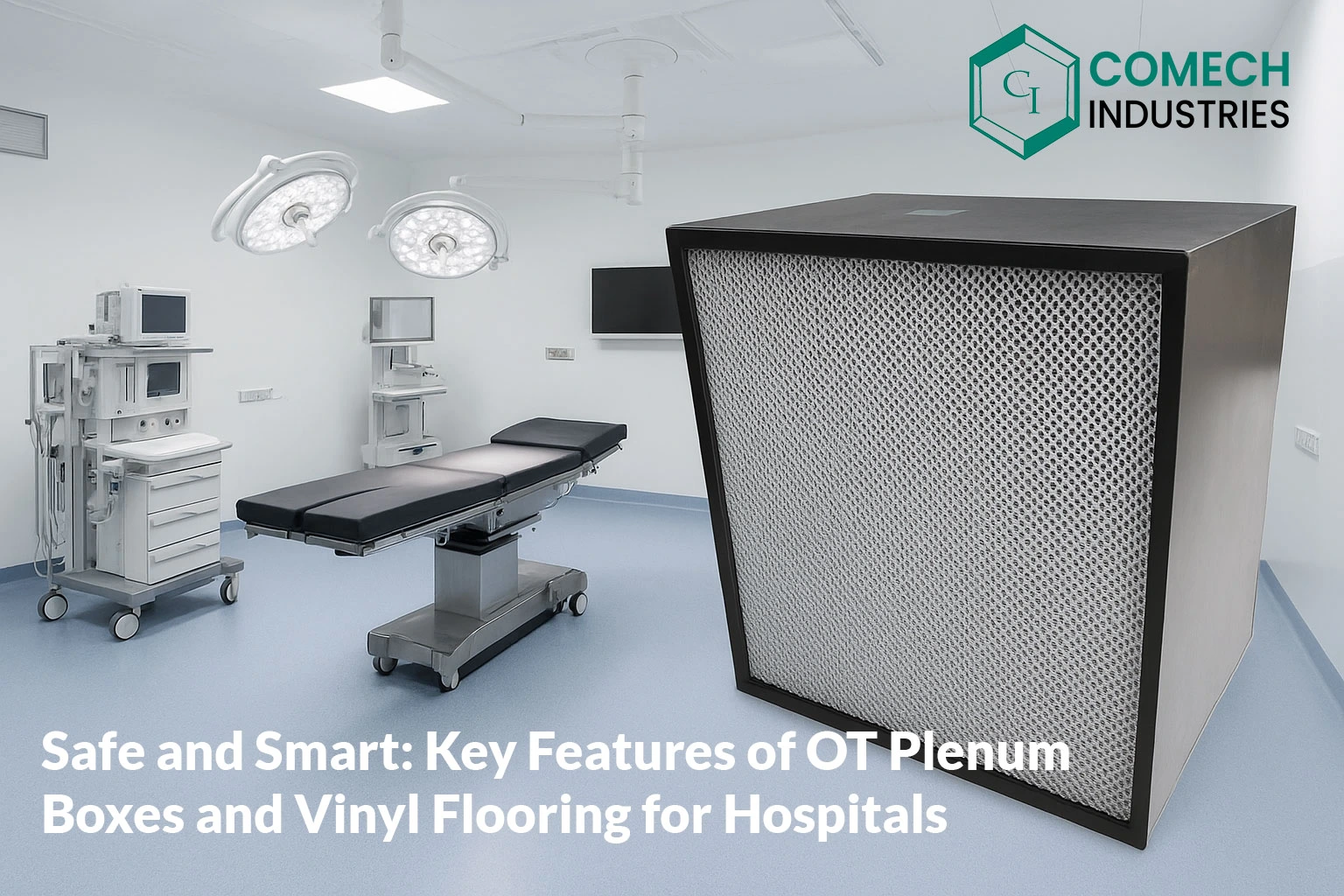
In modern healthcare environments, particularly in operating theatres (OTs), patient safety depends on maintaining an ultra-clean, controlled, and sterile atmosphere. Two often-overlooked yet critical components in achieving this are OT plenum boxes and vinyl flooring. While one ensures clean, directional airflow above the surgical zone, the other provides a hygienic, slip-resistant, and easy-to-maintain surface underfoot. Together, they play an essential role in infection control and operational efficiency.
OT Plenum Boxes – Ensuring Clean Air at the Source
An OT plenum box is a specially designed air distribution unit that delivers clean, filtered air directly into the operating area. Installed in the ceiling above the surgical table, it works in conjunction with HEPA filters to provide laminar airflow—a continuous, uniform flow of air that minimizes turbulence and prevents airborne contaminants from entering the sterile field.
Key Features of High-Quality OT Plenum Boxes
- Integrated Filtration – Equipped with H13 or H14 grade HEPA filters, capable of removing up to 99.995% of particles as small as 0.3 microns.
- Even Air Distribution – Designed to maintain laminarity at a velocity of 0.45 m/s ± 20%, ensuring optimal particle control.
- Low Noise and Vibration – Engineered for quiet operation, enhancing surgeon concentration and patient comfort.
- Durable Construction – Typically manufactured from stainless steel (SS304 or SS316) for corrosion resistance and easy cleaning.
- Seamless Integration – Can be customized to fit the OT ceiling layout, with provisions for lighting and other equipment.
Why It Matters:
Without a properly functioning plenum box, even the most advanced OT can face contamination risks. Laminar airflow directly above the surgical zone drastically reduces the chance of surgical site infections (SSIs) by ensuring that airborne contaminants are pushed away from the critical area.
Vinyl Flooring – Hygienic and Practical for Healthcare
Flooring in a hospital OT is more than just a surface to walk on—it’s a vital part of the infection control barrier. Vinyl flooring has become the preferred choice for hospitals because of its seamless finish, durability, and resistance to microbial growth.
Key Features of Hospital-Grade Vinyl Flooring
- Seamless Installation – Welded joints eliminate cracks and gaps where bacteria and dust can accumulate.
- Antimicrobial Properties – Some variants are treated with antimicrobial coatings to inhibit the growth of pathogens.
- Slip Resistance – Maintains grip under wet or dry conditions, reducing the risk of accidents.
- Chemical Resistance – Withstands cleaning agents, disinfectants, and chemical spills without degrading.
- Ease of Maintenance – Simple cleaning procedures help maintain hygiene without downtime.
- Aesthetic Variety – Available in a range of colors and patterns to suit hospital design themes and zoning.
Why It Matters:
Hospital flooring must handle heavy foot traffic, wheeled medical equipment, and frequent cleaning. Vinyl offers long-term performance while contributing to a safe and sterile environment.
The Combined Impact in OT Environments
When OT plenum boxes and vinyl flooring work together, the result is a surgical space that is both safe and efficient. The plenum box protects the sterile field from airborne contamination, while vinyl flooring prevents microbial build-up and supports stringent cleaning protocols. Together, they contribute to:
- Reduced risk of surgical site infections
- Compliance with ISO 14644 and NABH standards
- Improved comfort for surgical staff
- Lower long-term maintenance costs
Conclusion
Infection prevention in hospitals is a multi-layered process, and the right infrastructure plays a pivotal role. OT plenum boxes ensure that every breath of air in the surgical zone is clean and controlled, while vinyl flooring keeps the environment hygienic from the ground up. Hospitals that invest in these features are not only safeguarding patient health but also enhancing operational reliability.