
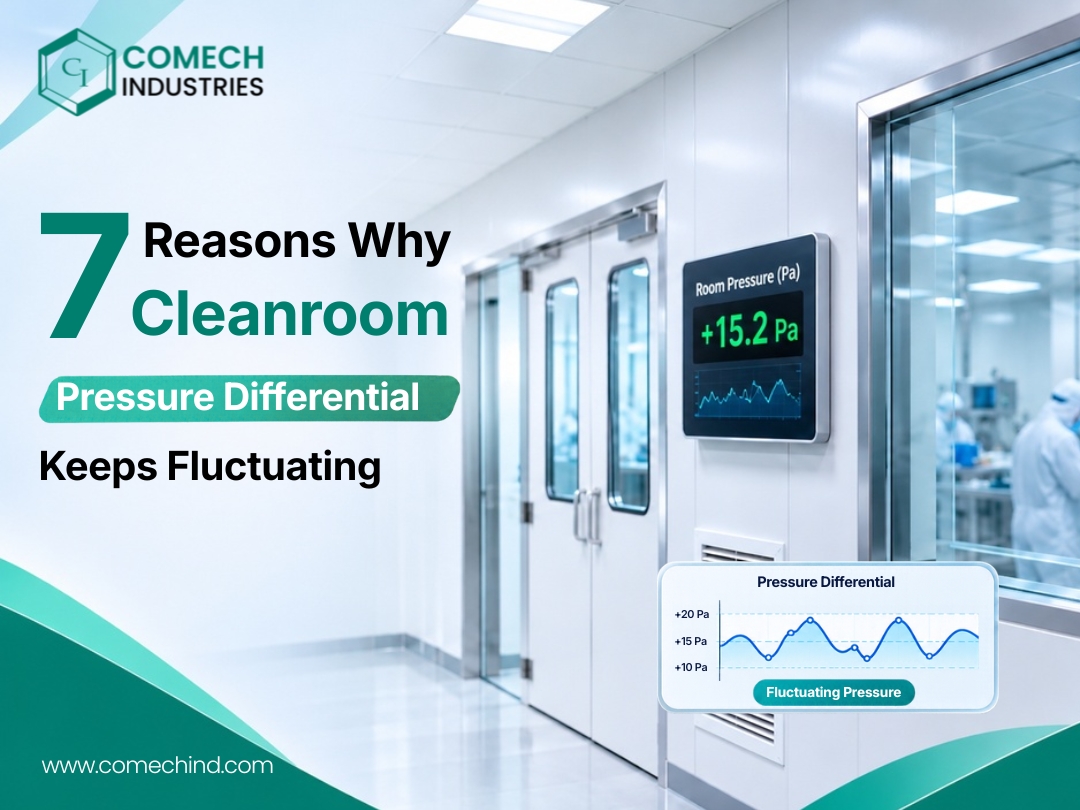
Maintaining stable pressure differential is essential for contamination control in pharmaceutical manufacturing facilities, laboratories and other controlled environments. However, cleanroom operators may experience fluctuating pressure readings even when the HVAC system appears to be working normally.
A sudden pressure drop, inconsistent readings between adjacent rooms or difficulty maintaining the required airflow direction can indicate an underlying problem with the facility’s ventilation system.
Why does cleanroom pressure differential keep fluctuating, and how can these issues be resolved?
The cause may involve several factors, including frequent door openings, improper airflow balancing, air leakage, clogged filters, or faulty monitoring instruments. Understanding these issues helps facility managers identify problems before they affect cleanroom operations.
1. Frequent Opening and Closing of Cleanroom Doors
Frequent door movement is one of the common causes of temporary pressure fluctuations. When a cleanroom door opens, the pressure boundary between adjacent areas changes, allowing air to move between them.
This can temporarily reduce the measured pressure difference and affect the intended airflow direction.
Common causes:
- Frequent personnel entry and exit.
- Unnecessary door opening during production.
- Simultaneous opening of both airlock doors.
- Damaged door seals or closing mechanisms.
How to resolve it: Use properly designed airlocks, maintain door-closing mechanisms and establish clear personnel movement procedures. Where required, door interlocking and suitable time delays can help control movement between areas.
2. Improper Supply and Return Airflow Balancing
Cleanroom pressure depends on the relationship between incoming supply air and outgoing return or exhaust air.
If the supply airflow decreases or the exhaust airflow becomes excessive, the room may struggle to maintain its designed pressure. Similarly, an incorrect airflow balance can affect the pressure relationship between adjacent rooms.
How to resolve it: Measure supply, return and exhaust airflow volumes. Inspect balancing dampers, verify fan performance and compare actual readings with the approved HVAC design. Rebalance the system whenever significant changes are made to the facility.
3. Air Leakage Through Walls, Ceilings and Door Gaps
Gaps around doors, ceiling panels, wall joints, utility openings and duct connections can create uncontrolled air leakage.
Even when the HVAC system is operating correctly, these leakage paths can affect the pressure difference between rooms.
For example, an improperly sealed opening created during electrical or utility installation may allow unwanted air movement between controlled areas.
How to resolve it: Inspect door seals, wall joints, ceiling connections and service penetrations. Seal unintended openings and verify room pressure conditions after structural modifications.
4. Clogged or Overloaded Air Filters
As air filters collect airborne particles, their resistance to airflow may increase. If the ventilation system cannot compensate for this additional resistance, the supply air volume may decrease.
This can disturb the balance between incoming and outgoing airflow, potentially affecting room pressure.
Warning signs include:
- Reduced supply airflow.
- Increasing pressure drop across filters.
- Changes in fan operating conditions.
- Difficulty maintaining designed room pressure.
How to resolve it: Monitor filter differential pressure, inspect filter condition and replace filters according to manufacturer recommendations and facility maintenance procedures.
Note: Filter pressure drop and room-to-room pressure differential are different measurements. An increase in filter resistance can contribute to room pressure problems, but does not automatically indicate a pressure imbalance.
5. Changes in Process Exhaust Airflow
Pharmaceutical manufacturing processes may require dedicated exhaust systems to remove dust, fumes or other airborne contaminants.
When additional exhaust equipment operates, it removes air from the room. If the supply airflow does not compensate for this change, the room pressure may decrease.
For example, a dust extraction system operating only during specific production activities may create pressure variations during different stages of manufacturing.
How to resolve it: Check pressure readings during actual production activities. Evaluate supply and exhaust airflow requirements together, and coordinate HVAC operation with process equipment.
6. HVAC Fan, Damper or Control System Malfunctions
Cleanroom pressure stability depends on the consistent operation of HVAC fans, variable frequency drives (VFDs), dampers and associated control systems.
A malfunctioning fan, incorrect VFD setting or faulty damper actuator can change airflow volume and disturb the pressure balance.
How to resolve it: Inspect fan performance, verify VFD operation, check damper positions and review HVAC control-system alarms. Regular preventive maintenance can help identify equipment problems before they affect cleanroom conditions.
7. Incorrect Pressure Sensor Placement or Calibration
Sometimes, the HVAC system is functioning properly, but the monitoring instrument displays inconsistent readings.
Incorrect sensor placement, blocked pressure sensing tubes, calibration errors or unsuitable reference points can affect measurement accuracy.
How to resolve it: Verify sensor installation, inspect sensing tubes and calibrate instruments according to manufacturer recommendations. Compare readings with a suitable calibrated reference instrument whenever inconsistent measurements are suspected.
How to Maintain Stable Cleanroom Pressure
Preventing pressure fluctuations requires a coordinated approach to ventilation, room construction and monitoring.
Facility managers should follow these practices:
- Maintain airflow balance: Regularly verify supply, return and exhaust air volumes.
- Inspect room integrity: Check doors, ceiling panels, wall joints and service openings for unintended leakage.
- Monitor pressure continuously: Use suitable differential pressure monitoring instruments in critical areas.
- Maintain HVAC equipment: Inspect fans, dampers, filters and control systems according to a preventive maintenance schedule.
- Review facility modifications: Reassess pressure relationships after changes to room layouts, equipment or exhaust systems.
Pressure requirements should be established according to the facility’s process, contamination-control strategy and applicable regulatory guidance. A single pressure setting is not suitable for every cleanroom application.
How Positive Pressure Modules Support Cleanroom Contamination Control
Maintaining positive pressure in designated cleanroom areas requires a controlled supply of filtered air. A Positive Pressure Module can support this requirement by supplying filtered air into a designated space.
COMECH Industries manufactures Positive Pressure Modules for pharmaceutical manufacturing facilities, laboratories, healthcare environments and other controlled applications.
Depending on the selected configuration, the modules offer HEPA filtration, different airflow capacities and customizable dimensions to suit facility requirements.
It is important to remember that a Positive Pressure Module is not a standalone solution for every pressure fluctuation. Proper HVAC design, airflow balancing, room sealing and pressure monitoring are equally important for maintaining stable operating conditions.
Conclusion
Cleanroom pressure differential fluctuations can indicate problems with airflow balancing, room integrity, filtration, exhaust systems or monitoring instruments. Identifying the underlying cause is essential before making HVAC adjustments or replacing equipment.
Regular monitoring, preventive maintenance and proper airflow management help pharmaceutical manufacturers maintain controlled cleanroom conditions.
If your facility requires a filtered air supply arrangement to support positive pressure, explore COMECH’s Positive Pressure Module for application-specific configurations.
FAQ
1. What causes cleanroom pressure differential to fluctuate?
Common causes include frequent door opening, improper airflow balancing, air leakage, clogged filters, changes in process exhaust airflow, HVAC equipment malfunctions and inaccurate pressure monitoring.
2. What is the ideal pressure differential for a pharmaceutical cleanroom?
The required pressure difference depends on room classification, process requirements and contamination-control strategy. A 10 Pa differential is referenced as guidance in certain pharmaceutical cleanroom applications, but the actual design setpoint must be established for the specific facility.
3. Can clogged HEPA filters affect cleanroom pressure?
Yes. Increased filter resistance can reduce supply airflow if the HVAC system cannot compensate, potentially disturbing room pressure balance.
4. How can cleanroom pressure be monitored?
Differential pressure gauges and digital monitoring instruments measure pressure differences between adjacent spaces. Critical pressure conditions may require continuous monitoring and documented recording.
5. How does a Positive Pressure Module help?
It supplies filtered air into a designated area to support positive pressure and reduce the risk of unfiltered air entering the protected space when properly integrated into the ventilation system.